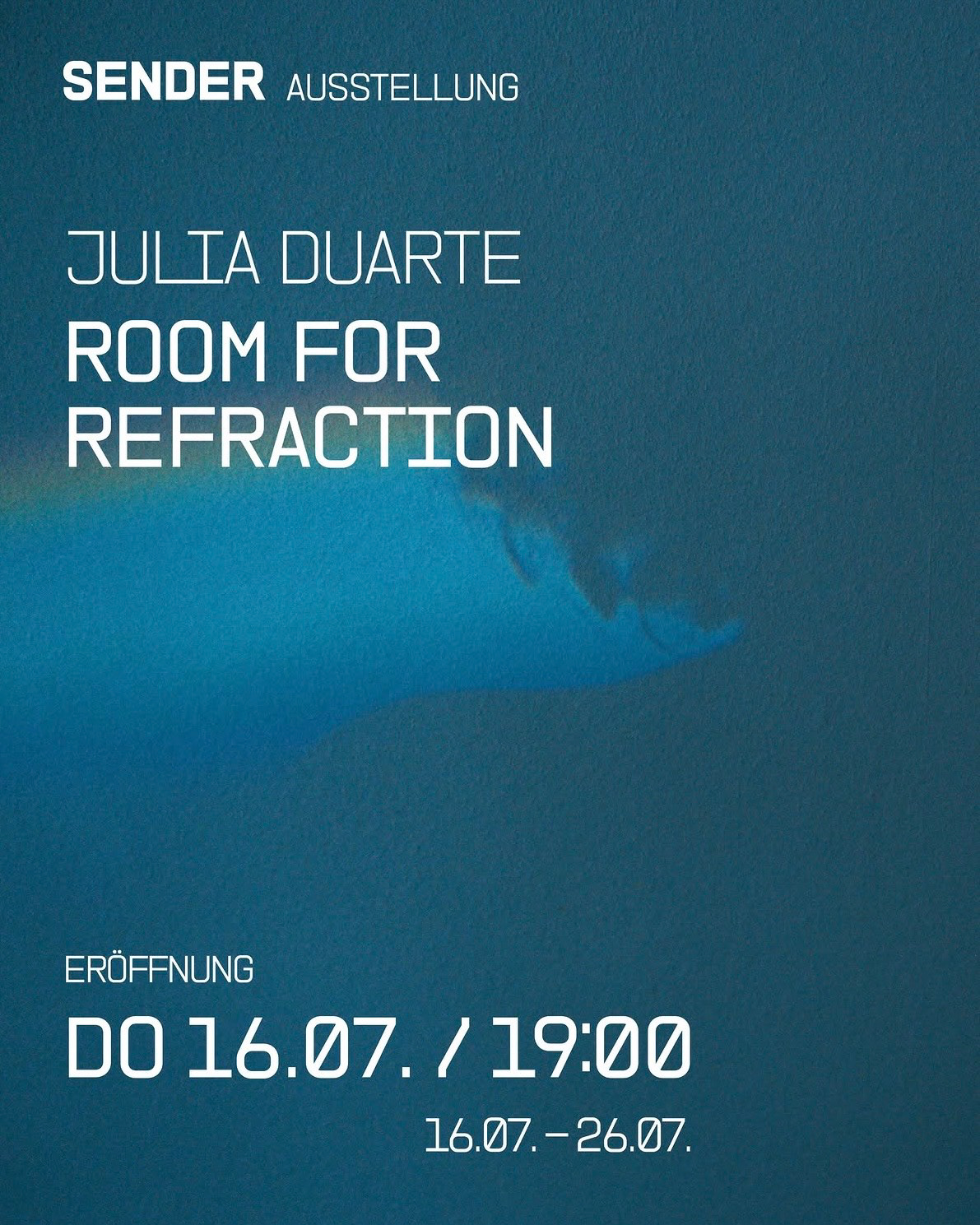
Wir freuen uns sehr, die erste Soloausstellung ROOM FOR REFRACTION der Fotografin und Filmemacherin Julia Duarte ankündigen zu dürfen. Das Thema ihrer Arbeit ist eine autobiografisch-künstlerische Auseinandersetzung mit Dreierbeziehungen - familiär, freundschaftlich, romantisch. Der SENDER wird hierfür zum Labor, indem wir ihre Fotografien als persönliche Experimente eines Erkenntnisprozesses mitverfolgen und miterleben dürfen.
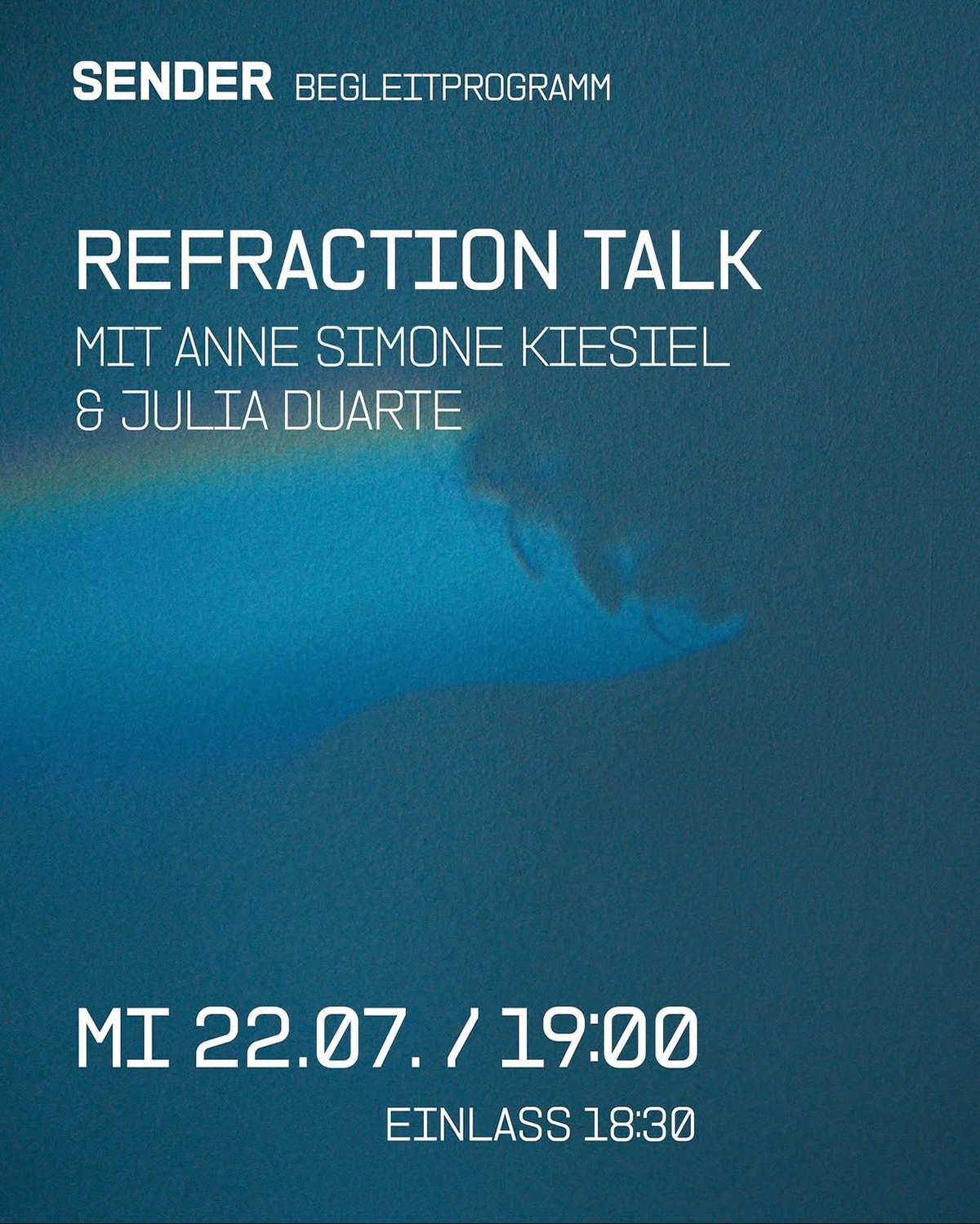
Wir freuen uns außerdem ganz besonders auf den Refraction-Talk mit Anne Simone Kiesiel, Kunsthistorikerin und freier Kunstkritikerin, die einen kunsthistorischen Exkurs mit einem Dialog mit der Künstlerin verbindet.
Wir freuen uns außerdem ganz besonders auf den Refraction-Talk mit Anne Simone Kiesiel, Kunsthistorikerin und freier Kunstkritikerin, die einen kunsthistorischen Exkurs mit einem Dialog mit der Künstlerin verbindet.
Eröffnung
Do 16.07. | 19:00
Öffnungszeiten 17. - 26. Juli
Sa + So | 15:00 - 18:00
Refraction Talk mit Anne Simone Kiesiel
Mi 22.07. | 19:00 | Ohne Anmeldung, eintrittfrei
Do 16.07. | 19:00
Öffnungszeiten 17. - 26. Juli
Sa + So | 15:00 - 18:00
Refraction Talk mit Anne Simone Kiesiel
Mi 22.07. | 19:00 | Ohne Anmeldung, eintrittfrei
EN
What does it mean to be complete? In her autobiographical artistic practice, filmmaker and photographer Julia Duarte explores triangular constellations - familial, romantic and platonic. In doing so, she breaks through the boundaries of dichotomies: between interior and exterior, body and mind, the natural and the constructed - towards a third entity that is more than a bridge or an in-between.
The prism serves Duarte as both central symbol and methodological tool. By photographing with and through a prism, she creates images of natural spaces and bodies, refracted and layered, fanned out into spectral colors - images that render a multiplicity visible and expand our space of perception. Nature in Duarte's work does not appear as an essentialist symbol of human interiority, but as a site of coexistence - a common ground where difference converges.
The exhibition space itself becomes a laboratory, where each picture works as an individual experiment, guiding the viewer towards a shared moment of clarity. Room for Refraction argues against completeness as a fixed state - and understands it instead as a constant process of expansion.
What does it mean to be complete? In her autobiographical artistic practice, filmmaker and photographer Julia Duarte explores triangular constellations - familial, romantic and platonic. In doing so, she breaks through the boundaries of dichotomies: between interior and exterior, body and mind, the natural and the constructed - towards a third entity that is more than a bridge or an in-between.
The prism serves Duarte as both central symbol and methodological tool. By photographing with and through a prism, she creates images of natural spaces and bodies, refracted and layered, fanned out into spectral colors - images that render a multiplicity visible and expand our space of perception. Nature in Duarte's work does not appear as an essentialist symbol of human interiority, but as a site of coexistence - a common ground where difference converges.
The exhibition space itself becomes a laboratory, where each picture works as an individual experiment, guiding the viewer towards a shared moment of clarity. Room for Refraction argues against completeness as a fixed state - and understands it instead as a constant process of expansion.
@juliaduartes @anne_simone_kiesiel @jennischurr
Mit freundlicher Unterstützung der Behörde für Kultur und
Medien Hamburg